Reading the Gap Between Two Prayer Apps: Which Setting Moved Fajr, Asr or Isha
Seventeen minutes between two phones in the same city, and neither app is at fault. Prayer timetables are built from conventions; which prayers disagree tells you which setting differs, and your mosque's schedule tells you which one to match.
 By Muslim App Editorial Team8 min read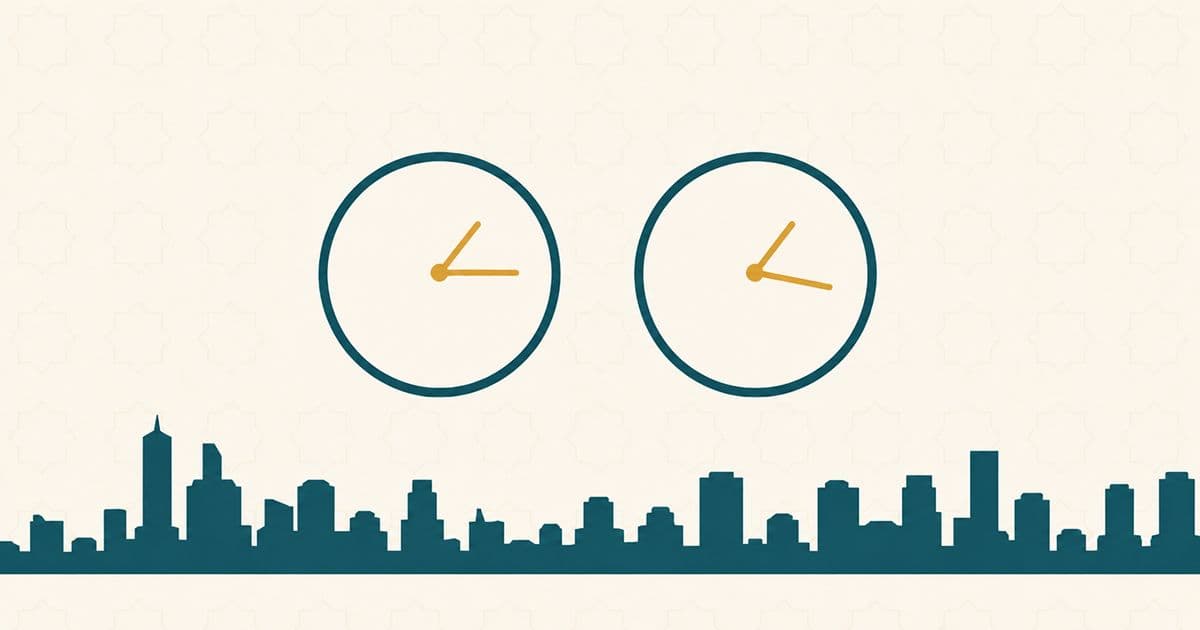
Key takeaways
- Two prayer apps showing different times for the same city are usually both computing correctly, from different conventions. A disagreement is not evidence that either app is broken.
- When two timetables disagree, the prayers they disagree on point to the setting that differs: Fajr and Isha to the calculation method, Asr alone to the Asr convention, and a minute or two on every prayer to location and rounding.
- The gaps are measurable. In Houston on one July day, switching between two widely used calculation methods moves Fajr by 17 minutes and Isha by 11, and switching the Asr convention moves Asr by 73 minutes while changing nothing else.
- An across-the-board error of an hour or more is different. That is not a convention but a location or clock fault.
- There is no single "true" timetable to find. The practical anchor is the schedule your own mosque follows, and an app's settings exist so you can match it.
Put two phones side by side in the same city and they can announce Fajr seventeen minutes apart, with neither app at fault. The disagreement has a shape, and the shape tells you which setting to look at.
Both apps can be right at the same time
Two apps can disagree with both correct, because a prayer timetable is computed rather than looked up, and the computation includes choices that scholars and institutions settled by convention. An app takes your coordinates and the date, works out where the sun will be, and then applies those choices: how dark the sky must count as dawn and as nightfall, how long a shadow marks the start of Asr, what to do in places where the sky never gets that dark. Two apps agreeing perfectly about the sun still disagree about the times when they are set to different conventions.
How prayer times are calculated explains the astronomy underneath and why it is the settled part. What matters here is the practical half: when two honest timetables disagree, the disagreement is confined to the times the differing setting governs. So before changing anything, look at which prayers moved.
The calculation method moves Fajr and Isha, and almost nothing else
The first setting to check is the calculation method. Each method is a published convention, usually named after the institution that issued it, and its job is to fix how far below the horizon the sun must sit for dawn and for nightfall. The open reference model published by PrayTimes states the choice plainly: "There are differing opinions on what angle to be used for calculating Fajr and Isha."
The effect is easy to measure. For Houston on 21 July 2026, the AlAdhan engine under the ISNA preset gives Fajr at 05:20 and Isha at 21:36. Switch only the method to the Muslim World League preset and Fajr becomes 05:03 and Isha 21:47: seventeen minutes earlier at dawn, eleven minutes later at night. Sunrise, Dhuhr, Asr and Maghrib do not move by a single minute, because in these presets none of them contains the chosen angle.
That is the signature to remember. Two apps set to different methods disagree about Fajr and Isha and agree about the middle of the day.
The Asr setting is a different kind of choice
Asr is not defined by an angle but by shadow length, and there are two established readings. PrayTimes records both: the convention followed in the Shafi'i, Maliki, Ja'fari and Hanbali schools starts Asr when an object's shadow equals its own height plus its shadow at noon, and the Hanafi convention starts Asr when the shadow is twice the object's length plus its noon shadow.
In an app this is one switch, and in the Houston example it produces the largest gap of any single setting. Houston, same date, same ISNA method: Asr falls at 17:04 under the first reading and 18:17 under the Hanafi reading, one hour and thirteen minutes apart, while every other prayer stays identical. Two apps disagreeing only about Asr are not miscalculating. They are answering under two different conventions, and the one to select is the one your mosque follows.
Maghrib usually agrees, and its exception is also a convention
Maghrib is the time that moves least between timetables, because in the widely used presets it is simply sunset. PrayTimes defines it as "soon after sunset" and gives the Sunni reading as sunset itself "with a precautionary delay of 1 to 3 minutes", which is why some printed timetables sit a few minutes after the computed moment on purpose.
The exception is principled, not sloppy. Some presets define Maghrib by an angle below the horizon rather than by sunset, reflecting a position in Shia jurisprudence that Maghrib waits for the redness after sunset to pass. AlAdhan's published method list carries Maghrib angle values of 4 and 4.5 degrees for two of its presets.
The difference is visible in the same Houston day: the Shia Ithna-Ashari preset puts Maghrib at 20:37 where the ISNA preset puts it at 20:21, sixteen minutes later. These two presets differ at Fajr and Isha as well, since each also carries its own twilight angles; the Maghrib gap is the part a sunset-based preset can never produce. So if two apps disagree at Maghrib by more than a rounding minute, they are following different definitions.
The same city is not one point
Every time on the list is computed for coordinates, not for a city name. One app reading live GPS and another pinned to a saved city are computing for two different places, and the result is a small, uniform shift. Houston downtown and Sugar Land, about thirty kilometres southwest, differ by one minute on almost every prayer of the same day, with identical settings.
Two more quiet sources of minute-level drift sit on top. Timetables are printed to the whole minute, so two engines can round the same instant to different sides of it. And per-prayer offsets are a standard feature rather than a hack: AlAdhan's own API exposes a tune parameter, a "Comma Separated String of integers to offset timings returned by the API in minutes", prayer by prayer. A difference of a minute or three across the board is the least meaningful kind of gap, and the easiest to close.
Far enough north, a third setting appears
At high latitudes in summer, the sky may never get as dark as a method's angle requires, and the calculation needs a rule for what to return. Engines expose that rule as an explicit choice: AlAdhan documents its high-latitude parameter as a "Method for adjusting times at higher latitudes. For example, if you are checking timings in the UK or Sweden", with three options named Middle of the Night, One Seventh and Angle Based.
Two apps with different rules can disagree at Fajr and Isha by far more there than any method gap produces. Scholars differ on which rule to follow, so if you live far enough north for this to matter, it is a question for your local mosque or scholar rather than a setting to guess at.
Reading a difference when you see one
Set the two sources side by side for the same day and compare prayer by prayer. The pattern narrows the cause to one place:
- Only Fajr and Isha differ: the two sources use different calculation methods. The deeper the required darkness, the earlier the Fajr and the later the Isha.
- Only Asr differs: they use different Asr conventions. Expect the Hanafi reading to be the later one.
- Maghrib differs by more than a couple of minutes: one source defines Maghrib by a post-sunset angle rather than sunset.
- Everything differs by a minute or three: different coordinates, rounding, or deliberate per-prayer offsets.
- Everything is off together by an hour or more: that is not a convention but a fault, usually a stale location or time zone, and it has its own guide: how to keep your schedule accurate when you cross US time zones.
So which timetable should you trust?
The honest answer is that there is no single true timetable hiding behind the apps. Each convention is published, internally consistent, and followed by real communities. What settles the question in practice is the convention your own community keeps, which makes your mosque the anchor: its schedule is the one you will actually stand in line for, so the useful move is not to hunt for the perfect app but to make your app match your mosque.
That takes three steps. Find your mosque's published timetable, from its noticeboard, its website, or by locating a mosque near you. Then set the app to the same conventions.
Muslim App computes "Truly location-based Adhan times from verified authorities, with madhhab and latitude adjustments when needed", lets you "choose different calculation methods from various Islamic authorities", and if a small gap remains, lets you "add or subtract minutes from each prayer time" until the schedule sits exactly on your mosque's. If you want the schedule pinned to a place rather than to your phone's GPS, you can "manually search and select your city" instead.
Then check the result against a published schedule you can see, the way this article checked Houston's times, or open the prayer times page for your own city. Matching your mosque does not make one convention truer than another. It makes your timetable your community's timetable, which is the thing a prayer app is for.
Same sun, different agreements
Over any city, the sun does one thing. The timetables describing it differ only where people had to agree on a definition, and those agreements are exactly the settings your app exposes. Download Muslim App for iOS or Android, set the calculation method, the Asr convention and the per-prayer minutes to match your mosque, and the times on your phone become the times your community keeps.
Frequently asked questions
Because prayer times are computed from settings that are conventions, and the two apps are set to different ones. The calculation method changes Fajr and Isha, the Asr convention changes Asr, and coordinates, rounding and per-prayer offsets shift everything by a minute or two. Identical astronomy under different conventions produces different, internally correct timetables.
About the author

Muslim App Editorial Team writes practical guides on prayer, building a consistent salah habit, and Muslim life at work and on the road. Where an article touches on religious rulings, it states only positions the four Sunni schools agree on, with their source, and leaves questions on which the schools differ, or that depend on your situation, to a qualified scholar. Our articles are not fatwas.