How to Find the Qibla Direction, and How to Check It
The qibla is an angle measured from true north, and from almost every US city it runs northeast. Four methods can give it to you, they fail for unrelated reasons, and the sun's widely quoted dates are not the ones that work here.
 By Muslim App Editorial Team7 min read
Key takeaways
- The qibla is a bearing measured from true north, and across the continental US it runs northeast: 45 degrees from Houston, 49 from Chicago, 58 from New York.
- It looks wrong on a map because a flat map is not the globe. The shortest path to Mecca curves north, and that is the direction every calculation uses.
- A phone app applies your local magnetic correction for you. A physical compass does not, and skipping it costs about 15 degrees in Seattle and 12 and a half in New York, in opposite directions.
- The sun gives an exact answer with no device at all, but the two widely quoted dates for it land at or before sunrise in the United States. The usable moments here are in mid-January and late November.
- Whether a given deviation matters for the prayer is a question of fiqh rather than geometry, and one for a scholar rather than a calculator.
Four things can tell you which way to face, and they fail for unrelated reasons. Knowing what each actually measures separates a good answer from a confident one.
The qibla is a bearing, and from America it points northeast
The qibla is an angle measured clockwise from true north, and across most of the United States it lands in the northeast quadrant: Houston 45.5 degrees, Chicago 48.7, New York 58.5, Seattle 17.6. From Anchorage it is 350.9, which is almost due north.
This surprises people, because Mecca sits south of most American cities on a map. The map is what misleads: on the Mercator projection that web maps use, a straight line is a line of constant compass bearing, not the shortest path.
The shortest path between two points on a globe is a great circle, and from the contiguous United States the great circle to Mecca leaves heading north of east and crosses the Atlantic well above the latitude of either end. That northeast reading is what a prayer app computes.
Not every community in North America has settled on the same convention, and some mosques face noticeably differently from what an app shows. Which convention to follow is a question of fiqh rather than of geometry, and one for your mosque or a scholar rather than for the phone.
Method one: the app, and the one thing it needs from you
An app needs your coordinates and nothing else. It computes the bearing from your position and shows it, and Muslim App offers a map mode and a compass mode, with its help pages listing "Qibla direction (compass method)" among the features "available without internet". If one mode is not behaving the other is available (the map needs a connection): "if the Maps method is not working, you can use the Compass method which uses your device's magnetic sensor", and you can "manually enter your location coordinates".
The map mode takes the phone's compass out of the problem. Rather than asking the magnetometer which way you are turned, it draws the bearing on the map from your position and you line it up with something you can see: a wall, a street, the edge of the building. Muslim App describes this as confirming "your direction according to the blue line we show from the location of the building or place you are in".
What an app cannot do is know your position better than you have told it, and a location fixed to the wrong block is enough to skew the qibla.
Method two: a compass, corrected for where you stand
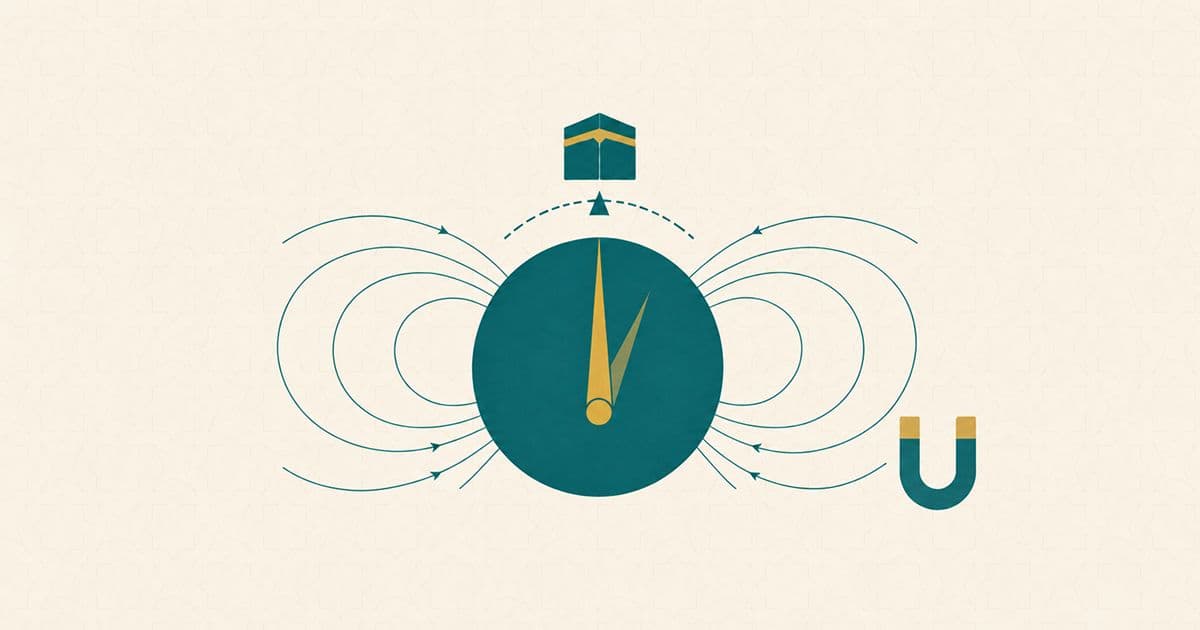
A magnetic compass does not point at true north, and the qibla bearing is measured from true north. The gap is called magnetic declination, and the US National Centers for Environmental Information, which publishes the model behind it, puts it plainly: a needle points along the magnetic field, "in a different direction than geographic north", and "a more precise direction is achieved by knowing the angle between them".
The correction is not small, and it does not run the same way everywhere. From the World Magnetic Model, July 2026:
| City | Qibla from true north | Declination | Set the compass to |
|---|---|---|---|
| Seattle | 17.6° | 14.9° east | 2.7° |
| Los Angeles | 23.9° | 11.4° east | 12.5° |
| Houston | 45.5° | 1.7° east | 43.8° |
| Chicago | 48.7° | 4.2° west | 52.9° |
| New York | 58.5° | 12.5° west | 71.0° |
Subtract an eastern declination from the true bearing, add a western one. Ignore the step and you are off by the declination itself: nearly 15 degrees in Seattle, 12 and a half in New York, in opposite directions, while Houston barely needs it. A qibla app knows your coordinates and applies this for you; a physical compass has no idea where it is, so you apply it yourself.
The field drifts, so the model is reissued on a schedule: the current version "was released on December 17, 2024, and will remain valid until late 2029". A compass can also simply misread, and the two ways a qibla compass goes wrong are the usual reasons.
Method three: the sun, on different days than you have read about
Twice a year the sun passes almost directly over the Kaaba, and at that moment every place that can see it gets a free qibla reading: "any shadow cast by vertical objects on earth will point directly away from the Kaaba". It needs no compass, no signal, no phone. The dates usually quoted are 27 or 28 May at about 12:18 Mecca time and 15 or 16 July at about 12:27, which is 09:18 and 09:27 UTC.
Those moments are close to useless in the United States. In 2026, 09:18 UTC on 28 May is 05:18 in New York, and sunrise that day is 05:29: the sun has not come up yet. The same source notes it arrives six minutes after sunrise in Boston, so low that the spot "must be completely unobstructed". Further west it is still the middle of the night.
The dates that do work here
The fix is the other half of the same phenomenon. Twice more each year the sun stands over the point exactly opposite the Kaaba, and shadows then point toward it rather than away. These antipodal moments fall in mid-January and late November, at 21:29 and 21:09 UTC, on a date that shifts by a day between years.
In 2026 that is the afternoon of 13 January and 28 November: 16:29 and 16:09 Eastern, 13:29 and 13:09 Pacific. Stand with your back to the sun and you face the qibla, or follow the shadow of a vertical edge.
Checked against the Naval Observatory's solar position formulas, the shadow at those instants matches the calculated bearing to within about a tenth of a degree, finer than a compass will resolve. Being a few minutes off costs roughly a degree, more in the north and west where the azimuth moves faster.
The sun is low then: about three degrees up in New York against a 16:51 sunset in January, so you need a clear view westward, while in Houston and Los Angeles it sits 23 and 31 degrees high. You can check its position for any moment with NOAA's calculator.
Method four: someone else already did the work
A mihrab is a qibla decision a community already made and built into a wall, so if you can see one you can align to it. You can find a mosque near you as you would prayer times.
How much deviation from the exact bearing matters for the prayer is a question of fiqh rather than of geometry, and worth putting to your local scholar rather than to a compass app.
Checking one answer against another
Any two of these that agree are worth more than one alone. An app can hold a stale position; a compass can sit next to a steel beam; the sun does neither, but from here it answers on two days a year.
So establish it once, carefully, where you pray most, then mark it against something fixed: a window, a doorway, the line of a wall. A direction remembered as "the corner of the room" survives a dead battery and a drifting compass.
One angle, four ways to find it
The qibla from any spot is a single number, and the methods differ only in how well each measures it. The app is fastest and corrects for the magnetic field on your behalf; a compass works anywhere once you apply that correction yourself; the sun is exact on the days it is available; a mihrab carries a decision already made. Muslim App offers a compass mode that works offline and a map mode that needs a connection, alongside prayer times for the same location. Download it for iOS or Android and check the result against something you can see.
Frequently asked questions
Northeast from almost everywhere in the continental US. The exact bearing depends on your city: about 45 degrees from Houston, 49 from Chicago, 58 from New York and 18 from Seattle, all measured clockwise from true north. Alaska is the exception, where the shortest path runs close to due north. An app computes the figure for your own coordinates.
About the author

Muslim App Editorial Team writes practical guides on prayer, building a consistent salah habit, and Muslim life at work and on the road. Where an article touches on religious rulings, it states only positions the four Sunni schools agree on, with their source, and leaves questions on which the schools differ, or that depend on your situation, to a qualified scholar. Our articles are not fatwas.