Praying Salah Around a University Timetable: Why Monday's Plan Fails on Tuesday
A class timetable is easy to treat as one busy schedule. Registrars publish something more specific: blocks that start together but run to different lengths, labs that one registrar leaves off the grid, and a new grid every term. That is why a plan that worked in September stops working in January.
 By Muslim App Editorial Team7 min read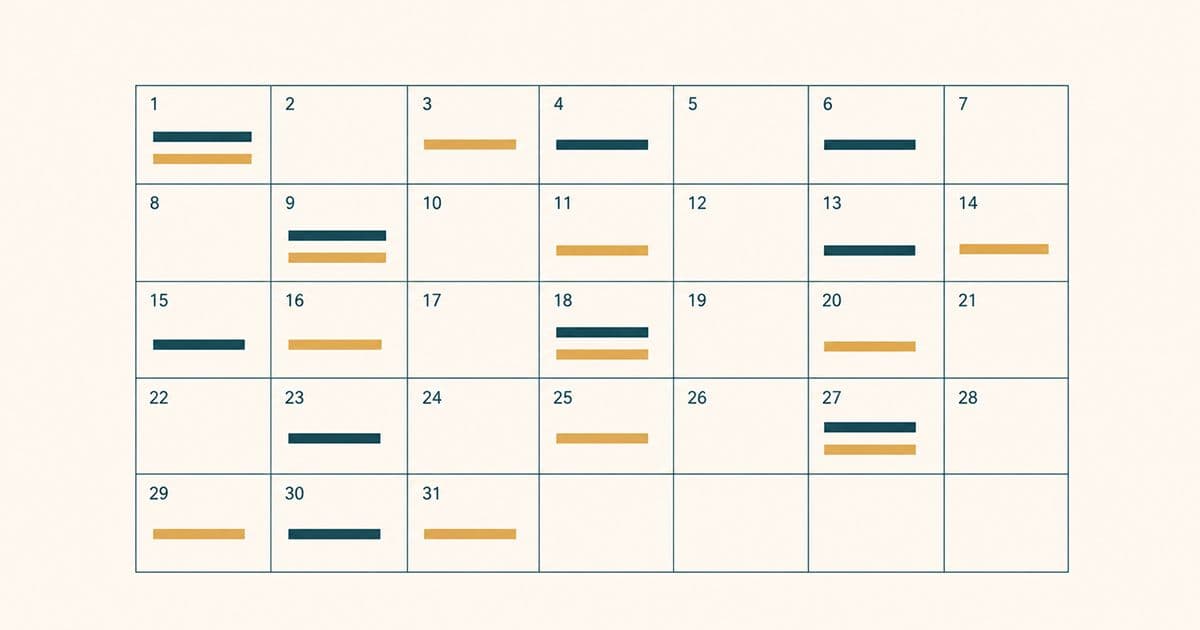
Key takeaways
- A timetable is built from blocks a university publishes in advance, so the shape of your week is knowable before term starts.
- Two classes can start together on different days and end thirty minutes apart, because block length depends on each course's meeting pattern: which days, and how many times a week.
- The gap between consecutive classes is ten to twenty minutes at the universities here that set it out: Coventry's rules fix it, and Utah's block tables imply it.
- Labs may sit outside the grid: Drexel's registrar says lab and studio sections are not bound by its official time blocks, while Utah publishes slots for linked labs.
- The grid expires with the term, exam week replaces it again, and the next one is published before it begins.
It is easy to treat a timetable as one undifferentiated busy schedule. Universities publish something more specific than that, and the detail is useful: the week is assembled from standard blocks, the blocks are not all the same length, and the whole arrangement is replaced a few months later.
Your week is built from published blocks
A timetable is not improvised. It is assembled from standard time blocks that the university publishes, usually before you enrol. The University of Utah's registrar sets out four of them: on Monday, Wednesday and Friday, 50-minute blocks starting at "7:30 am, 8:35 am, 9:40 am, 10:45 am, 11:50 am, 12:55 pm, 2:00 pm, 3:05 pm, 4:10 pm" and 80-minute blocks starting at "8:05 am, 11:50 am, 1:25 pm, 3:00 pm"; on Tuesday and Thursday, 80-minute blocks from "7:30 am, 9:10 am, 10:45 am, 12:25 pm, 2:00 pm, 3:40 pm" and 50-minute discussion or lab slots.
The starting times overlap more than you would expect, and the page says why: other 50-minute blocks "should not be used as it would overlap with Tuesday and Thursday 80 minute blocks in prime time". The alignment is deliberate. What is not aligned is how long a block lasts.
Same start, different finish
That is where a week comes apart. At Utah a class beginning at 10:45 on Monday ends at 11:35, and a class beginning at 10:45 on Tuesday ends at 12:05. Same start, thirty minutes between the two finishes. A plan that puts a prayer just after that class works on one day and is half an hour out on the other, and nothing about the plan was wrong.
Drexel publishes the same shape with its own numbers: one-hour blocks on Monday, Wednesday and Friday at "8:00-8:50, 9:00-9:50, 10:00-10:50" and onward, against hour-and-a-half blocks on Tuesday and Thursday at "8:00-9:20, 9:30-10:50, 11:00-12:20". Colorado Boulder makes the grid binding, telling departments that in centrally controlled or priority-scheduled rooms "you must follow the meeting location's standard day and time patterns based on your class's meeting frequency". Published and enforced is a good combination: it means the shape holds all term.
The gaps are published too, and they are short
The space between two consecutive classes is a fixed number rather than a matter of luck, and it is smaller than most plans assume. Coventry University Group's teaching guidance requires that "all teaching must start on the hour" and that "all teaching events must finish at 10 to the hour", which fixes ten minutes between one class and the next.
Elsewhere it is a little longer. Utah's own tables give fifteen minutes between consecutive 50-minute blocks and fifteen to twenty between the 80-minute ones. Ten to twenty minutes is the real figure, and it is also the time you spend walking between buildings, so it is worth treating as transit rather than as an opening.
The dependable openings are the blocks where you have nothing scheduled at all, and those are visible the moment the timetable is issued. Edinburgh defines "the standard teaching day" as "from 9am to 6pm, Monday to Friday", and recognises that "learning and teaching sometimes takes place outside of these hours"; Drexel lists its own blocks running to 21:50. Laying the week out as blocks rather than as days, and marking the slots that are empty, turns a vague worry into a short list. This is a scheduling argument, not a claim about which part of a window is better to pray in.
Where labs sit outside the grid
Long sessions are the hard case. Drexel's grid includes three- and four-hour blocks, but its scheduling page states that "lab and studio sections are not bound by official time blocks". Everything above applies to lectures and seminars at Drexel; Utah publishes 50-minute slots for linked discussion and lab sections, so this varies by institution.
That is worth knowing in the other direction from how it usually feels. Where a lab sits outside the published grid, one that runs across an entire prayer window is not something you can predict from it, which is exactly why it is worth asking about rather than waiting to discover. Whether the session has a scheduled break and when it falls, whether people are expected to step out, and how long it actually runs are all answerable in the first week, when they are ordinary logistics.
Whether a session is a reason to delay a prayer or combine it with another is a question for a scholar rather than for a timetable; on combining, the schools divide: the Hanafi school allows combining only at Arafah and Muzdalifah during Hajj, while the other three also allow it for travel, though they differ over its conditions and over other excuses. If a prayer's time has already passed, the four Sunni schools agree that an obligatory prayer a Muslim missed after puberty, whether forgotten, slept through or skipped, is made up, as al-Jaziri's comparison of the four schools sets out, and that prayers not performed during menstruation or post-natal bleeding, or before a person first became Muslim, do not have to be, a point on which the Kuwaiti Encyclopedia of Islamic Jurisprudence records no disagreement; how, when and in what order to make it up, and special cases such as long unconsciousness or loss of reason, are also for a scholar. What a timetable can settle is narrower: where the breaks are, and whether anyone minds.
The grid expires with the term
Whatever you work out is valid for one term. The University of Cincinnati publishes "Fall Semester 2026 Term Dates: August 24 – December 12, 2026", with classes running to "Saturday, December 5" and "Exam Week Sunday, December 6 – Saturday, December 12". Then it begins again: "Spring Semester 2027 Term Dates: January 11 – May 1, 2027".
Illinois publishes its own boundaries rather than the same ones, with a "first day of instruction" on 24 August and a "last day of instruction" on 9 December. The dates differ, the structure does not: a fixed teaching period, then an exam period on a different timetable, then a new grid.
So the unit that matters is the term rather than the week. An hour with the new timetable in the first days of a semester covers the fifteen weeks that follow. Prayer times themselves also drift over a period that long, and how prayer times are calculated explains why.
What to set once
If you have moved for university, the times on your phone belong to somewhere else until you change them. That is a location question rather than a planning one, and moving changes the schedule itself rather than your plan for it; Muslim App's documentation notes that "you can also manually search and select your city from the location settings within the app".
Muslim App lets you mark each prayer as performed and look back at previous days to see what you marked. What it holds steady is the schedule: prayer times for the city you are studying in, and a mosque directory for a city you have just arrived in.
Reading the grid instead of the day
Four things that make prayer awkward on a campus are written down before term starts: blocks of different lengths, gaps of ten to twenty minutes, labs that one registrar leaves outside the pattern, and an end date in December. None of them is a surprise once the timetable is open in front of you.
The work is an hour, once a term. What comes out is not a resolution to do better but something duller and more durable: a list of which empty block belongs to which prayer, on each kind of day.
Frequently asked questions
Ask in the first week: a lab outside the university's grid is the part of the week you cannot predict. Drexel states that lab and studio sections are not bound by the official time blocks. Find out whether there is a scheduled break. Whether a prayer may be delayed around a lab is for a scholar, and so is combining it, where the schools differ (per Ibn Rushd, the Hanafi school allows it only at Arafah and Muzdalifah during Hajj).
About the author

Muslim App Editorial Team writes practical guides on prayer, building a consistent salah habit, and Muslim life at work and on the road. Where an article touches on religious rulings, it states only positions the four Sunni schools agree on, with their source, and leaves questions on which the schools differ, or that depend on your situation, to a qualified scholar. Our articles are not fatwas.