Salah on Rotating Shifts: Plan by the Shift, Not the Weekday
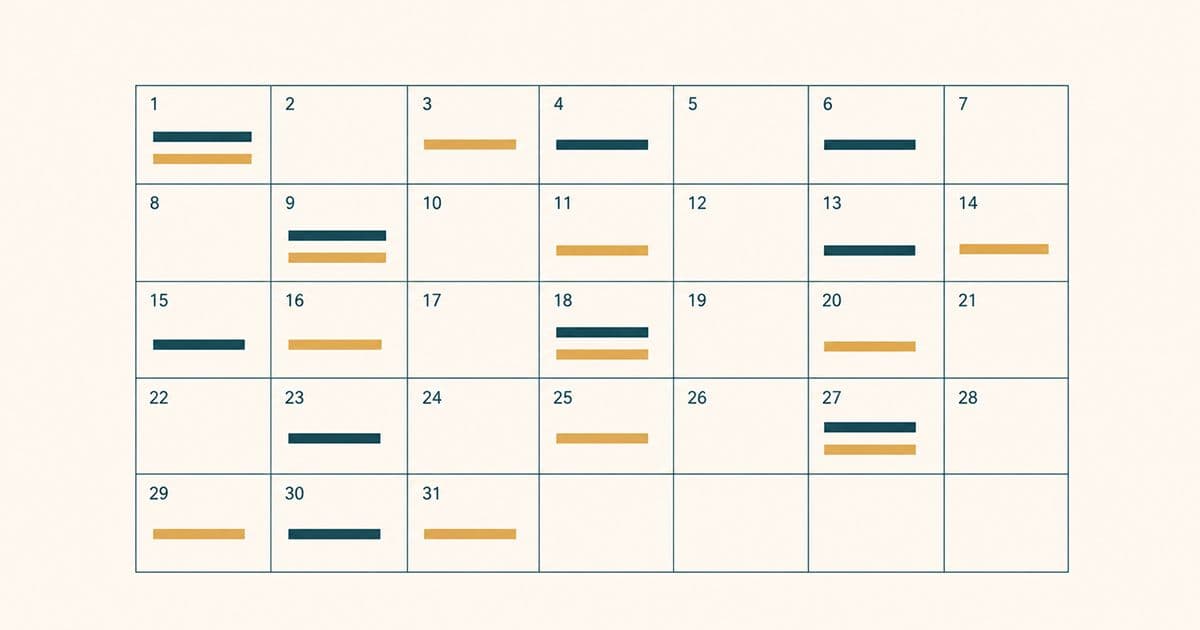
A weekly routine assumes this Tuesday looks like last Tuesday. On a rotating roster it does not: the same weekday can be a day shift one week and a night shift the next. The workable unit is the shift itself, planned once for each type and checked as the seasons turn.
 By Muslim App Editorial Team11 min read
Key takeaways
- On a rotating roster, plan prayers by shift type rather than by weekday, because the same weekday can fall on a different shift from one week to the next.
- Rosters repeat a small set of shift types, such as the two or three shifts a day of many rotational systems, so a few plans cover the whole cycle.
- Which prayers begin during a shift moves with the season: on a 7am to 7pm day shift in New York, four do in December and two in June.
- Breaks belong on the same map: British law gives a 20-minute break beyond six hours, US federal law none, though some states set their own.
- Changeover days and the sleep after a night shift work like extra shift types, and each one needs its own short plan.
If your roster moves you between days, evenings and nights, advice written for a desk and a nine-to-five does not fit, because it assumes this Tuesday looks like last Tuesday. A nurse on rotating twelve-hour shifts, a warehouse or production-line worker, a supermarket supervisor on a rolling rota: none of them has that week. What they need is a different unit of planning.
Why a weekly routine fails on a rotating roster
A weekly routine is keyed to the day of the week, and on a rotating roster the day of the week stops predicting anything. A NIOSH booklet on shiftwork describes a typical pattern as "five days on a single shift followed by two days off", and adds that on a rotating schedule "the worker will change to a new shift after the days off".
So the Tuesday that was a day shift this week can be an evening shift next week, and a plan that attached Asr to Tuesday's afternoon break has nothing to attach to. The same booklet defines rotation as "changing work times from day to evening, or day to night", and measures its speed as "the number of consecutive day, evening, or night shifts before a shift change occurs", with examples running from two days per shift to twenty-one.
Rotating rosters are the smaller part of shift work. In the Bureau of Labor Statistics' figures for 2017 and 2018, 2.4 percent of wage and salary workers usually worked a rotating shift, against 5.9 percent on evening shifts and 3.6 percent on nights; applied to the table's total of 144.3 million workers, that is roughly 3.5 million people. The rotating share reached 5.2 percent in wholesale and retail trade and 4.8 percent in leisure and hospitality.
Twelve-hour shifts are common on hospital wards. A survey of 22,275 registered nurses in four US states, carried out between 2005 and 2008, found that "sixty-five percent of nurses worked shifts of 12–13 hours".
A roster is a few shift types on repeat
However irregular a roster looks on a calendar, it is assembled from a short list of repeating parts. Canada's occupational health and safety centre describes rotational shiftwork as shifts that "rotate or change according to a set schedule", run around the clock or as "semi-continuous, running 2 or 3 shifts per day", with workers taking "turns working on all shifts that are part of a particular system".
That changes the planning question. Instead of a month of dates, there are two or three shift types plus the days off, and each type starts and ends at the same clock times whenever it comes round. A plan written for the late shift is valid every time the late shift appears, whichever weekday it lands on.
The NIOSH booklet makes the same point from the employer's side: "Workers should know their schedule well ahead of time, so they can plan their rest, child care, and contact with family and friends." Prayer belongs on that list. Knowing the roster in advance means the planning can happen once, when it is published, rather than on the morning of each shift.
Which prayers fall inside each shift
On a 7am to 7pm day shift in New York, four prayers begin during the shift in December and two in June. Each shift type holds a different set, and the set moves through the year even though the shift hours do not. Counting a prayer as inside a shift when its time begins while you are at work, common rosters in New York look like this on the two solstices of 2026.
| Shift | 21 December | 21 June |
|---|---|---|
| Day, 7am to 7pm | Dhuhr, Asr, Maghrib, Isha | Dhuhr, Asr |
| Night, 7pm to 7am | Fajr | Maghrib, Isha, Fajr |
| Early, 7am to 3pm | Dhuhr, Asr | Dhuhr |
| Late, 3pm to 11pm | Maghrib, Isha | Asr, Maghrib, Isha |
| Night, 11pm to 7am | Fajr | Fajr |
The rows were computed with the AlAdhan prayer time API, and the two solstice columns come out the same under the ISNA, Muslim World League and Jafari conventions and with the Hanafi Asr convention. The twelve-hour rows repeat for Chicago, Houston and Seattle under ISNA. This is a scheduling count of where prayer times begin, not a claim about how long any window lasts or which part of it is better to pray in, which is a separate question. The count is keyed to the shift, not to the date. On fixed hours one row would describe every week of the season; on a rotation the row that applies to you changes with the shift you are working.
Between the solstices, and in other cities
Between the solstices the count changes in steps. Under ISNA in New York the day shift holds four prayers from the start of November to late February, three in the weeks either side, and two from mid-March to mid-September. Under the other conventions checked, the February, March and September steps move by up to ten days; the November step comes on the same day in all four, because it is the clocks going back, not the calculation, that moves Isha before 7pm.
On an eight-hour rotation in New York under ISNA, the early shift holds Dhuhr all year and Asr only from November to early February, the late shift holds Maghrib and Isha all year, and the night shift holds Fajr. Under the Hanafi Asr convention the early shift holds Asr for only about seven weeks around midwinter, and in Houston, further south, it never does. Further north and further south the dates move again, which is why the map is worth building for your own city.
Why a prayer crosses a fixed finishing time as the year turns is covered in the seasonal mechanics of a workday. For your own map, the prayer times for your city, checked month by month, are enough: the rows above were built from nothing more than daily prayer times and the roster's start and end hours.
Put the breaks on the same map
A list of prayers per shift is half the plan; the other half is where each shift's breaks fall. Break rules differ between countries and, in the US, between states, so the breaks have to be read off your own contract and roster rather than assumed. This is general information about what the rules say, not legal advice about your situation.
In Great Britain, Acas, the workplace advisory service, sets out the right to a rest break of at least 20 minutes for most workers on a day of more than six hours, a break that should be "planned in advance" and taken "during the working day, not at the start or end of the day". It adds that "a 12-hour shift does not mean they're entitled to a 40-minute break, but the employer should consider it."
In the United States the Department of Labor states that "federal law does not require lunch or coffee breaks". Where short breaks are given, "usually lasting about 5 to 20 minutes", federal law counts them as paid working time. Some states set their own rules: Washington requires "a paid rest period, free from duties, of at least 10 minutes for every 4 hours worked".
How long a prayer takes
One published estimate of how long a prayer takes comes from guidance for NHS staff and managers by the British Islamic Medical Association and partners, written mainly for non-clinical settings: "the recommended 10-15 minutes includes the act of purification (washing) required before prayer". On that estimate a 20-minute break holds one prayer with room to spare.
Put each shift type's breaks beside its prayers. Where a break falls during a prayer's time, the plan is simply to know which break; where none falls near it, that prayer is the one to raise, and what an employer has to allow, and how to ask, is covered in praying at work and school. Like the count above, this is a scheduling map rather than a view on where a prayer's time ends or which part of it is better, which are questions for a scholar.
Changeover days and the sleep after nights
The days between shift types deserve rows of their own. A changeover compresses the day: Acas notes that a worker "might not be able to take their full 11 hours uninterrupted rest when their shifts change", giving the example of a move "from doing 3pm to 11pm shifts to doing 6am to 3pm shifts".
Direction matters as well. The NIOSH booklet distinguishes a forward rotation, "from day to evening to night shift", from a backward one, "from day to night to evening shift". Which way your roster turns decides which prayers land on the changeover day, so that day is worth writing out separately rather than borrowing the plan from either side of it.
The sleep after a night shift is part of the pattern too. In the New York example under ISNA, a sleep block ending at 3pm contains Dhuhr all year and Asr from November to early February, or for only about seven weeks around midwinter under the Hanafi Asr convention, so it needs the same treatment as a shift: note which prayers begin inside it. Waking from sleep for a prayer is a separate question, and the article on waking for Fajr covers the sleep side of it. Days off move on a rotating roster as well, and a free day without a shift's fixed points is a separate problem with its own fix.
Fridays on the roster
A rotating roster puts Friday on a different shift type as the cycle turns, which makes Jumu'ah a planning question as well as a religious one. The roster shows weeks ahead which Fridays land on a shift covering the midday prayer, and that is the practical part: knowing early enough to ask about a swap or a changed break.
What the app can follow, and what it cannot
Muslim App can hold the times, but its documentation describes nothing that follows a rotation. Its prayer alerts are configured per prayer and by weekday, and the product documentation describes the control as "for each prayer time, tick the days individually", which suits a pattern that repeats every seven days.
A roster that changes shift every week does not repeat every seven days, and the documentation describes no rotating or date-based schedule, so alerts set by weekday will drift out of step with it and need checking on changeover days. What does carry over is the timetable. The documentation describes a yearly list, "the whole year's prayer times, month by month", which is the raw material for a seasonal map like the one above.
What this article does not take up
Three questions sit next to this one and are not answered here: whether prayers may be combined on a long or overnight shift, how missed prayers should be made up, and how Jumu'ah applies to someone rostered through it. Each is a question of fiqh for a qualified scholar rather than for a roster.
Where to start
The next time a roster is published, sit down with it once. Write down the shift types it uses, mark which prayers begin inside each one this season, put the breaks beside them, and circle the prayers with no break near them. Add a row for changeover days and one for the sleep after nights.
That sheet is the plan, and it holds until the season or a clock change moves prayers across the shift boundaries. In the New York example under ISNA, the day shift's count changed four times in 2026: twice between late February and mid-March, once in mid-September and once on the night the clocks went back. Keep the times in Muslim App, and redo the sheet when the count changes.
Frequently asked questions
Plan by shift type rather than by date. List the shift types on your roster, note which prayers begin inside each one this season, and mark where each shift's breaks fall. In New York, a 7am to 7pm day shift contains four prayer start times in December and two in June, while the night shift holds one and three, under common calculation conventions. The plan needs checking as the seasons turn and the clocks change.
About the author

Muslim App Editorial Team is the in-house content team behind Muslim App, an all-in-one app for prayer times, Qibla direction, Quran and dhikr. We write practical guides on prayer, building a consistent salah habit, and Muslim life at work and on the road. Where an article touches on religious rulings, it is reviewed for accuracy before publication, and differences between scholarly opinions are stated rather than resolved.