You Know How to Pray. You Just Don't Know This Mosque.
The uncertainty is not religious. You know the prayer. What you do not know is whether this building has one entrance or two, where the wudu area sits, and how much the posted congregation time actually tells you.
 By Muslim App Editorial Team6 min read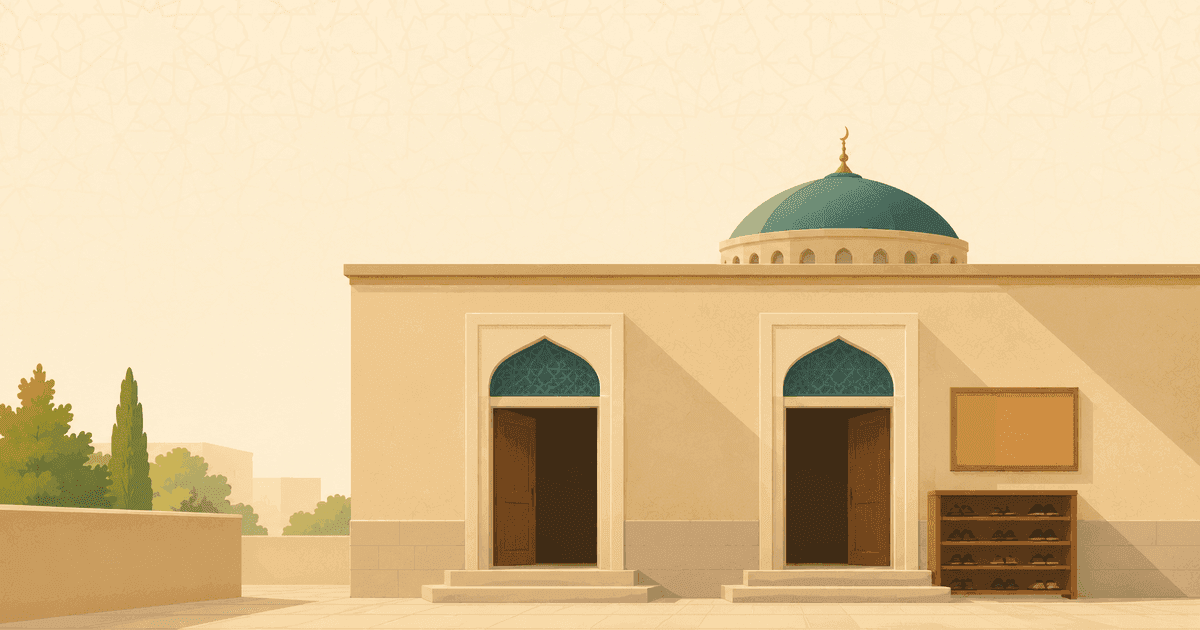
Key takeaways
- The uncertainty in an unfamiliar mosque is usually spatial rather than religious. The prayer does not change; the building, the layout and the local timing practice do.
- Most American mosques were not built as mosques. The 2020 US Mosque Survey found 37 percent purpose-built, with the majority purchased and converted from other uses.
- Room layout is not uniform and has been measured. Two-thirds of mosques use a divider for the women's section, a share that has not moved since 2000.
- The posted congregation time follows no single convention. Some mosques publish iqamah as minutes after the adhan, others as a fixed clock time.
- The 2020 survey does not record how mosques arrange their entrances, so which door to use is something you learn on arrival or by asking.
This is not an article about how to pray, and it assumes you are not learning. You know the wudu, the rak'ahs and where to stand. What you do not know is this particular building: whether there are two entrances, where the wudu area sits, which room the women's section is in, and whether the time on the noticeboard is when anything actually starts.
What does not change
The part that travels with you is larger than it feels in an unfamiliar car park. The prayer is the same prayer, performed the same way. The qibla still points at the same Kaaba, whatever bearing your compass gives you here. The times are calculated from the sun and owe nothing to the building.
What varies is what the community built around that: the shape of the room, the number of doors, the sign on the wall and the minutes between the call and the line forming. Those are institutional facts rather than religious ones, and they are worth treating as information to collect rather than as a test you might fail. A family household builds that kind of structure around the prayer too, and what happens to it when you move out is a separate question.
What the building used to be
Entrances are hard to predict partly because most American mosques were not designed as mosques. The 2020 US Mosque Survey, which counted 2,769 mosques and interviewed leaders at 470 of them, reports that 37 percent were purpose-built, and that "the majority of mosques are purchased, ranging in structure from former churches to houses".
A converted house has the doors a house has, and a former church has the doors a church has. The survey does record one entrance fact: 78 percent of mosques have wheelchair accommodations at their entrance, which the report's authors attribute to legal requirements. Beyond that, what the front of the building looks like is not something a national dataset can tell you.
Size is just as uneven, and the survey publishes the spread rather than only an average. In 2020, 18 percent of mosques drew a Jum'ah attendance of fifty or fewer, while 23 percent drew more than five hundred. Arrival, parking and shoes work differently at those two ends.
How the rooms are arranged
Layout is the part that has actually been measured. The 2020 survey found that two-thirds of mosques use a divider for the women's prayer space and one-third do not, and that this split "has remained steady since 2000".
The report also records how the split varies. It notes that "two-thirds of African American mosques (66%) have no barrier as compared to 31% of immigrant mosques that do not use a divider", and it associates the same split with several other variables, including how a mosque approaches Islamic legal reasoning. Why mosques differ here, and what the arrangement ought to be, are questions the report itself presents as contested, and they are not taken up here.
What matters on arrival is narrower. The arrangement is not uniform, so there is no single correct layout you were supposed to have memorised. The wudu area is the other unknown, and the survey does not record it: neither report notes where ablution facilities sit or how they are signposted. That is a gap in the data rather than a finding about buildings.
The time on the noticeboard
The gap between the adhan and the congregation forming is set by each mosque, and there is no shared convention for publishing it. As of August 2026, one mosque publishes its iqamah as an offset: "Fajr – 30 mins after Adhan", "Maghrib – 2 mins after Adhan", with different waits for different prayers in the same building.
Another publishes fixed clock times, adhan in one column and iqamah in the next, so the wait is whatever the arithmetic happens to be that day. A third publishes a yearly iqamah schedule and adds the caveat on its own website: "Iqama times are set by the masjid and may vary." Any of the three can change without notice, which is the point.
Two related questions are not this one. Why your app's adhan time differs from the board is its own settings question, and Jumu'ah, which each mosque schedules independently, is better planned before the trip.
What to settle before you go, and what to ask at the door
Two things are worth settling in advance and neither takes long. Confirm the mosque exists and how far it is, and know that this is roughly the limit of what a directory can tell you. Everything past the door is local knowledge that lives in the building.
Muslim App's mosque directory covers the first part. The product documentation describes what the app shows you: markers on a map, with "the mosque's name and distance" on the card when you tap one. Requesting directions hands off to your phone's own maps app. One constraint matters for travel: that screen "requires location permission", and "selecting a city manually isn't enough here".
The inside of the building is another matter. The product guide does not mention iqamah times, wudu areas, entrances or the women's section, and in the app, tapping a mosque on the map shows its name and distance on a card, none of which answers which door to use.
Which leaves the shortest route, which is asking. Where wudu is, and which entrance you want, are the two questions someone by the door answers in a sentence, and they are usually quicker than any of the guesses.
Two things are not taken up here: what to pray on entering, and what to do if you arrive after the congregation has begun. Both are questions of fiqh for a qualified scholar rather than for a page about buildings.
Where to start
Before the next unfamiliar mosque, check the distance and the day's timetable, and let the building answer the rest in the first two minutes. Look for the shoe rack, look for a second door, and if the board shows an offset rather than a clock time, do the arithmetic once and it holds all day.
Then ask where wudu is, rather than working it out by walking. Finding a mosque at all, when you are moving through an airport or a strange city, is finding one in the first place, and it is worth reading with Muslim App open beside it.
Frequently asked questions
There is no general answer, and that is a gap in the data rather than an oversight. The 2020 US Mosque Survey records whether a mosque has a divider inside and whether its entrance is wheelchair accessible, but it does not record how entrances are arranged. Since most American mosques are converted buildings, the doors are whatever the original building had. A shoe rack is a good sign you have found the right one.
About the author
Muslim App Editorial Team writes practical guides on prayer, building a consistent salah habit, and Muslim life at work and on the road. Where an article touches on religious rulings, it states only positions the four Sunni schools agree on, with their source, and leaves questions on which the schools differ, or that depend on your situation, to a qualified scholar. Our articles are not fatwas.