Muslim Prayer on a Business Trip: What to Settle Before You Fly
Most travel advice for Muslims answers the fiqh question about shortening prayers. The part that actually sits with you is different: a handful of ordinary decisions about the hotel, the phone, the agenda, security and dinner, all made before you leave.
 By Muslim App Editorial Team10 min read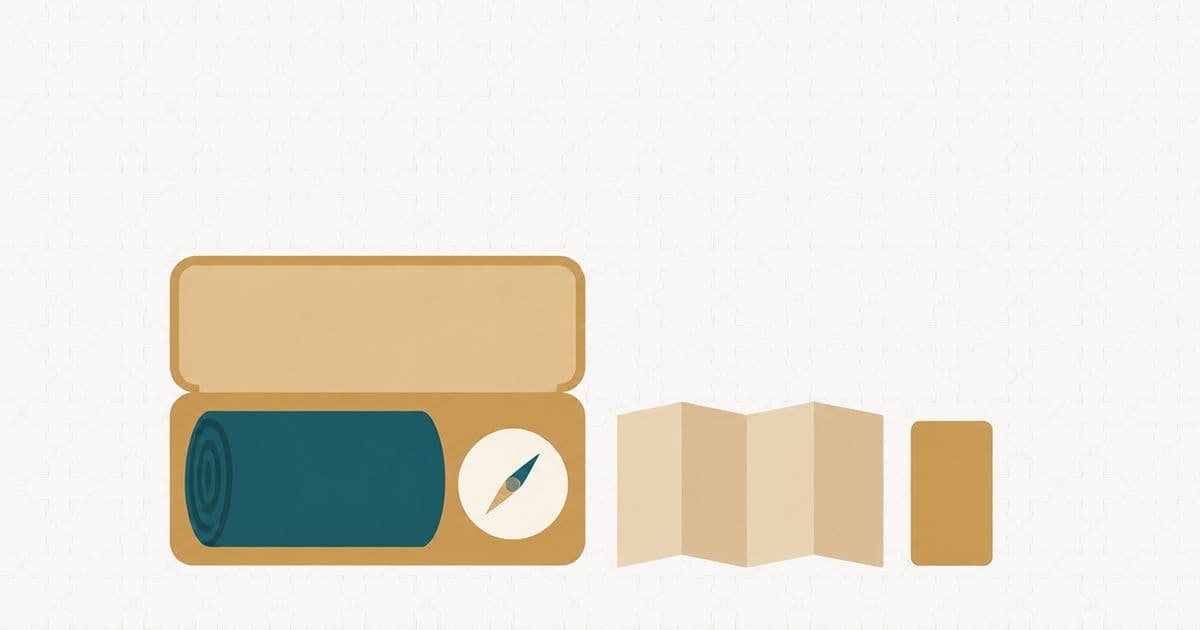
Key takeaways
- A business trip is decided at your desk: the hotel, the phone, the agenda, security and the dinner are all cheaper to settle before departure.
- Book the room as a prayer space. Business hotels rarely publish in-room prayer provision, so judge the floor space from the photographs and check the neighbourhood.
- Two phone settings travel badly: an offset tuned to your mosque at home, and anything you meant to download and did not.
- A prayer break is a scheduling detail while the agenda is still a draft, and an interruption once it has been circulated.
- TSA suggests carrying religious items in a container that can go through the X-ray on its own, in clear plastic rather than metal.
Most travel advice for Muslims answers the question of shortening and combining prayers on the road. This covers the part that sits with you: the ordinary decisions, all of them made before departure, that determine whether five daily prayers fit inside a working trip or fight it.
Why a trip breaks a routine that holds at home
At home the day is largely yours and the room is known. On a business trip the schedule belongs to a client, the room changes every night, and there is no default place to pray. This article treats what follows as a planning problem rather than a question of intention.
The infrastructure around this is growing, but unevenly. The 2026 edition of the Mastercard-CrescentRating Global Muslim Travel Index reports that the global Muslim travel market reached 196 million international arrivals in 2025, up 11.3 percent year on year, and projects that by 2030 it will reach 262 million arrivals and USD 310 billion in annual expenditure. Its ACES framework groups prayer facilities, halal dining and accommodation together under Services, which is to say they are amenities a destination has either chosen to build or has not.
That is the whole problem in one sentence. Nothing on the list is guaranteed at the particular hotel, terminal or restaurant on your itinerary, and you find out on arrival. What you do control is the week before departure, while the agenda is a draft and the booking is still open. Five decisions belong in that week.
Book the room as if it is your prayer space
The hotel room is the only space on the trip you hold for the whole stay, which makes it worth choosing as a prayer space and not only as a bed. Two things decide whether it works: clear floor area inside the room, and what sits within walking distance of it.
Some hotels do provide for prayer directly. Four Points by Sheraton Makkah Ibrahim Al Khalil lists "Prayer friendly envoirment, In-room prayer mat & Holy Quran" among its published highlights. Hilton publishes similar detail for its Makkah properties, though at building level, listing one as offering "a prayer hall with views of Al Haram". What the chains advertise tracks the market they are selling into rather than a company-wide standard, so a room in Frankfurt or Chicago is best booked on the assumption that nothing is provided.
That makes the room photographs more useful than the amenity list. What you are looking for is an uninterrupted stretch of floor rather than the narrow channel between bed and wall: usually the space at the foot of the bed, or beside a desk. A folding travel mat weighs almost nothing.
The neighbourhood matters most when the trip crosses a Friday. Checking which masjids sit near a candidate hotel is worth doing before booking rather than after, because changing hotels is trivial at that stage and impossible later. The nearby mosques directory in Muslim App maps masjids around a location, which is the same check on either side of the booking.
The phone settings that travel badly
The guide to keeping your schedule accurate across US time zones walks through pointing the app at the destination. Two smaller things belong in the week before, because neither can be fixed in the air.
The first is an offset you may have set and forgotten. Muslim App lets you "add or subtract minutes from each prayer time to match your local mosque", which is a good reason to use it at home and a poor one to leave it running abroad. An offset tuned to a masjid in your own city travels with you and is wrong everywhere else, so clearing it before a trip takes seconds and saves a week of notifications landing a few minutes out.
The second is anything you want available without a connection. The app's documentation is specific about what survives a lost signal: "many features of Muslim App work offline. Prayer times for your saved location, Qibla direction (compass method), and downloaded Quran content are available without internet." Downloaded is the operative word for the Quran. A long-haul flight is exactly when you want it and exactly when nothing will download, and the article on offline prayer times and qibla sets out what keeps working with no signal at all and what does not.
One check is worth doing before you close the laptop. Open the Qibla once at home so you know it responds, rather than meeting a permissions prompt for the first time in an unfamiliar room. The article on compass mistakes explains what throws a compass off indoors and how to read it correctly.
Put the prayers in the agenda while it is still a draft
A trip agenda is written by someone else, and the cheapest moment to shape it is before it circulates. Ten minutes requested at the planning stage is a scheduling detail. The same ten minutes requested mid-session, in a room of people, is an interruption.
Knowing what you are asking for comes first. Prayer times at the destination are not the ones on your phone until you change the location, and the intervals between them shift with latitude and season, so an agenda that looks comfortable from home can run a workshop straight through Asr. Reading the destination's prayer times while the draft is in front of you turns a vague need into a specific request for a specific gap.
Friday is the case worth raising early. Jumu'ah is a weekly fixture near the middle of the day, and individual masjids set their own times for it, so the workable slot has to be read off a specific masjid rather than assumed. A host who would gladly have worked around it often cannot once flights and rooms are booked, which is why it belongs with the travel dates rather than with the arrival.
How far a journey has to be before prayers are shortened, how long a stay can last while they still are, and whether they may be combined, are where the schools differ: the Hanafi school allows combining only at Arafah and Muzdalifah during Hajj, while the other three also allow it for travel, though they differ over its conditions and over other excuses, so all three are questions to put to a scholar. They sit outside what an agenda conversation can settle, which is narrower: which minutes, and which room.
Airport security is a packing question first
Pack for the X-ray belt rather than for the terminal. The US Transportation Security Administration publishes specific guidance on religious items, and following it removes most of the friction.
TSA presents checked and carry-on baggage as two options, and says of the second that "you may wish to pack religious items in carry-on baggage in a container that can be separated from other belongings and placed by itself in a bin for X-ray screening". It recommends "using a clear plastic container or bag or easily opened to remove religious items for screening", and states plainly: "Do not use a metal container." A folded prayer mat and a cap handled that way reach the belt as one visible tray instead of an unexplained bundle.
Head coverings have their own published rule. TSA states that "persons wearing head coverings, loose fitting or bulky garments may undergo additional security screening, which may include a pat-down", that "a pat-down will be conducted by a TSA officer of the same sex", and that "if an alarm cannot be resolved through a pat-down, you may ask to remove the head covering in a private screening area". The private option exists and can be asked for rather than negotiated.
Airside, lounge access is worth checking against the ticket you already hold. Announcing a new lounge concept in June 2026, Emirates said its prayer rooms come "with ablution facilities and Qibla direction integrated into the design", though it launched at two airports with others following later, which makes it a check to run on your route rather than an assumption. Where a terminal offers nothing of the kind, the guide to prayer spaces on the go covers what makes a spot inside it workable.
Decide the dinner before the dinner decides you
The client dinner is easiest to handle when you are the one who books it. Offering to choose the restaurant reads as hospitality rather than as a constraint, and it settles the food question days before anyone is standing outside a steakhouse at eight o'clock.
What booking the venue does not settle is whether to be at a table where alcohol is served. That is a question of fiqh, and one to put to a scholar rather than to a travel guide. What follows covers only the arranging.
Where the choice of venue is not yours, the dietary note belongs with the invitation rather than with the waiter. Conferences and corporate events collect dietary requirements as routine administration, and a line sent to the organiser in advance is unremarkable. The same sentence at the table becomes a conversation about you.
Labels abroad deserve a second look. A peer-reviewed survey of certification practice records that "no single halal standard is recognized worldwide" and that certification bodies adopt different standards, so a halal sign in one country may rest on a different basis than the one behind the sign you trust at home. For one client dinner, choosing the venue early does most of the work; the article on halal food on work trips covers how to check what a halal claim rests on in an unfamiliar city.
The trip you planned at your desk
None of this asks for more discipline on the road. One decision stays outside that list because it cannot be made in advance: the building itself, which you read at the door rather than at your desk. It moves five decisions into the week before, where each one costs a few minutes: the room with floor space in it, the phone with its home-mosque offset cleared, the agenda with a gap in it, the tray at security, and the restaurant you picked. A trip arranged that way does not need improvising on day two.
Muslim App carries the parts that travel with you: prayer times for a location you can set in advance, a Qibla compass that works offline alongside a map mode that needs a connection, widgets that put upcoming prayer times on your home and lock screens, and a mosque directory for the city you land in. Download it for iOS or Android before the next trip rather than during it.
Frequently asked questions
Settle the room, the agenda and the dinner before you fly, because those three decide the rest. Book a hotel with clear floor space and a masjid within reach, ask for the gaps you need while the agenda is still a draft, and offer to choose the restaurant. Almost everything that goes wrong on a trip was left undecided at a desk the week before.
About the author

Muslim App Editorial Team writes practical guides on prayer, building a consistent salah habit, and Muslim life at work and on the road. Where an article touches on religious rulings, it states only positions the four Sunni schools agree on, with their source, and leaves questions on which the schools differ, or that depend on your situation, to a qualified scholar. Our articles are not fatwas.