Your First Apartment Doesn't Come With a Salah Routine
If salah held at home and slipped after you moved out, the usual verdict is willpower. The likelier explanation is that the household ran the routine: its adhan, its timetable, the people praying nearby. None of that moved in with you.
 By Muslim App Editorial Team6 min read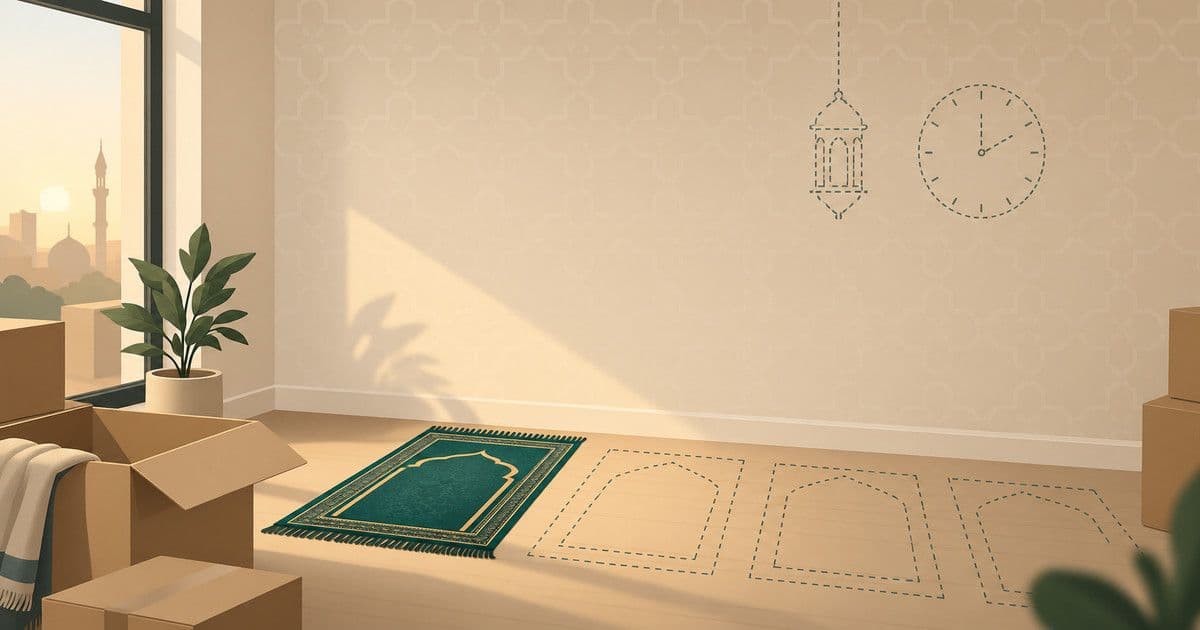
Key takeaways
- A salah routine that held at home often belonged to the household: its adhan, its timetable, the people praying nearby. Moving out removes those, not your intention.
- If the routine was never run by you alone, this is not a lapse to recover from: there is no earlier version to restore, only a first one to build.
- In studies of habits such as how people travel to work, moving home loosened old habits for a limited time; one experiment suggested the window lasted three months.
- The tasks specific to a move are few: point the app at the new city, choose a place to pray, and find other Muslims to pray with.
- An app can take over the call and the timetable. The people who prayed around you are the one part no device replaces.
If you prayed five times a day at home and have struggled since moving out, the usual verdict is willpower. The likelier explanation is structural.
For many people the routine at home was run by the household: someone had the adhan playing, the evening meal waited for Maghrib, a parent was already on the mat when you walked past. That structure stayed at the old address. Your intention came with you.
You did not lose a routine. You left one behind.
Someone returning to salah after a long break had a routine of their own and lost it, and rebuilding it is a different subject with its own plan. Someone who has just moved out may never have run the routine alone. The times, the place and the company were supplied by the house, so there may be no earlier version to restore, only a first one to build.
What studies of early adulthood show, and what they do not
Studies of early adulthood find that religious practice falls further than religious belief. Following thousands of American teenagers into their twenties, Uecker, Regnerus and Vaaler found that "only religious participation suffers substantial declines in young adulthood". Among those who had attended services at least monthly as adolescents, about 69 percent attended less often as young adults. Across the wider sample, only one in five rated religion as less important than they had as teenagers.
That study measured attendance at services in a largely Christian American sample, not salah, and it did not test moving out as a cause. It tied faster decline to other changes of early adulthood, including cohabitation and drug and alcohol use, while marriage slowed it; a move is rarely the only thing changing.
Among U.S. Muslims, the Pew Research Center found in 2017 that 33 percent of adults aged 18 to 29 say they pray all five salah daily, against 53 percent of those aged 55 and older, while younger and older Muslims "attach similar levels of importance to religion". That is a gap between age groups at one moment, not a record of what happens to one person after a move. Both findings fit the pattern described here; neither proves it.
Why it does not come back on its own
A day off removes the working week's fixed points and Monday returns them, which is a different problem with its own fix. A move is one-way. The call from the next room, the shared meal times and the family praying together do not return on any day of the week, so waiting for the old rhythm to reassert itself means waiting for something that is not coming.
Research on house moves adds a time limit. Analysing 18,053 people in the UK's Understanding Society survey, Thomas, Poortinga and Sautkina concluded that moving home weakens habits, "but only for a short period". In a field experiment with 800 participants, Verplanken and Roy found a behaviour-change intervention more effective among recently relocated participants, and the results suggested the window of opportunity lasted three months after the move.
Both studies concern environmental behaviours, such as how people travel to work, not prayer, so three months is not a deadline for salah. What carries over is the direction: the weeks after a move are when old habits are weaker, which makes them a practical time to set new ones.
What a move adds to the setup
Most of the method for building a prayer routine is shared with anyone rebuilding one, and the two articles linked above cover it. A move adds three tasks of its own, and the weeks after it are a practical time to do them.
Point the app at the new city
Muslim App calculates prayer times for your location, and its setup documentation notes a catch for anyone who has moved to a new city: if you chose your city by hand, "the app won't change a city you set yourself", and the times keep following the old city until you pick the new one.
Choose the place
The family home had a place where prayer happened. An apartment has one only once you choose it: a corner, and a mat that stays where it is. Finding the qibla there, and checking it a second way, settles the direction for that spot.
Find the people
This is the part no device replaces. Praying beside family, or knowing they were praying in the next room, was part of what kept the times. In a home of one, that company has to be found outside it, among friends, relatives or a local community, and the mosque directory lists the masjids in your new city if a mosque is where you want to look. Walking into one for the first time is easier with a little preparation.
What this article leaves to a scholar
Two questions often arrive with a move and are not answered here: whether praying alone at home, rather than in congregation, changes anything, and what is owed for prayers missed since moving out. Both are questions of fiqh for a qualified scholar, not for a page about routines.
Where to start
Do the three move-specific tasks while the move is still new: check which city the app is using, choose the prayer spot and settle its qibla, and find the people you would like to pray with. For the rest of the method, attaching prayers to fixed points and rebuilding a routine step by step, the two articles linked above cover it.
None of it needs more resolve than you already have. It needs the parts the old house used to supply, in place before the move stops feeling new. Muslim App can hold the call and the times; the place and the people are yours to arrange.
Frequently asked questions
The likelier change is the structure, not you. At home the routine was often carried by the household: someone else's adhan, meal times set around prayer, people praying nearby. Moving out removed those supports while your intention came with you, which is why the practical work after a move is setting up the supports yourself rather than summoning more resolve.
About the author

Muslim App Editorial Team is the in-house content team behind Muslim App, an all-in-one app for prayer times, Qibla direction, Quran and dhikr. We write practical guides on prayer, building a consistent salah habit, and Muslim life at work and on the road. Where an article touches on religious rulings, it is reviewed for accuracy before publication, and differences between scholarly opinions are stated rather than resolved.