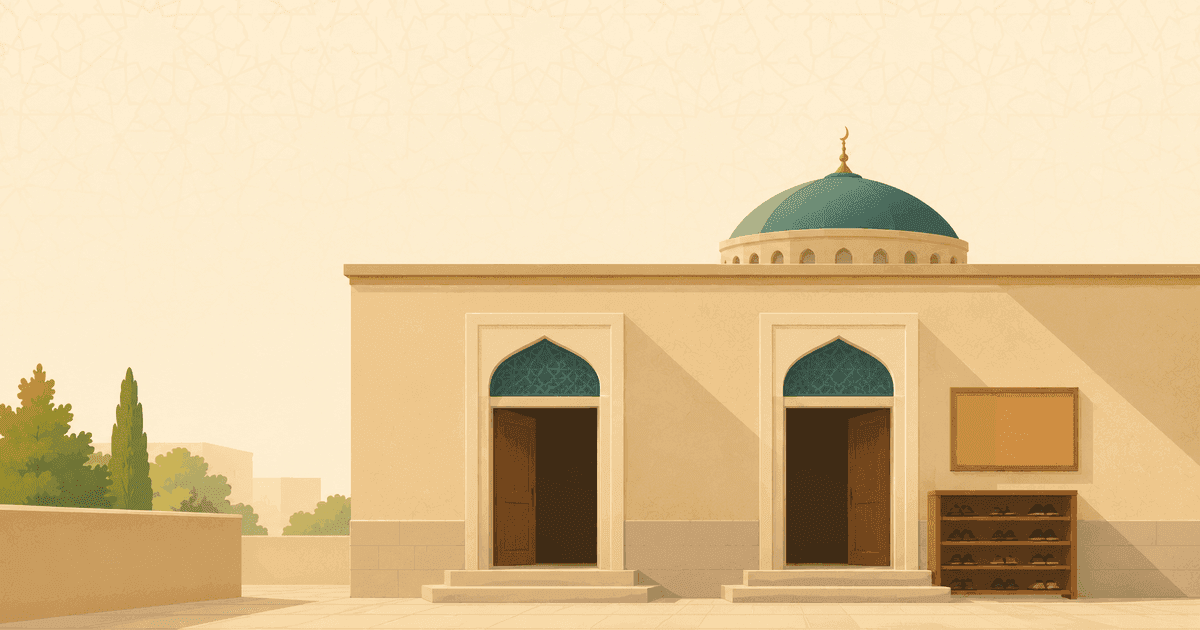
Where to Pray Salah Away From Home: Airports, Malls and Unfamiliar Cities
A prayer room on a facilities page is not the same as a place you can actually use. One airport publishes a foot washing station in one concourse and no water at all in another. Where each kind of building documents its prayer space, and what to do in the ones that document nothing.
 By Muslim App Editorial Team8 min read
Key takeaways
- The fastest route to a prayer space in a large building is its own website, under services or facilities, where the gate detail that search results drop actually lives.
- A listed prayer room does not guarantee water. Seattle-Tacoma publishes a foot washing station in one concourse room and states there is no water at all in the other.
- Which side of security a room sits on matters more than its distance. Heathrow's Terminal 4 lists one room before security and one after, and only one is reachable once you clear.
- Malls rarely sign prayer rooms from the concourse. Dubai Mall lists them on every level and routes guests through the concierge desk, the mall app or the touchmaps.
- When nothing is listed, work down a fixed order: operator directory, staffed desk, a mosque within travel time, then a quiet corner clear of the walking paths.
A layover runs long, Asr is twenty minutes out, and the practical question is where the floor is. Airports, shopping centres and unfamiliar city blocks each answer that question in a different place, and each has one source that is more reliable than a search engine.
Start with the building's own directory
The building that owns the room is the building that documents it. Large airports and malls publish prayer and multi-faith rooms on their own websites under services, facilities or amenities, with the terminal, level and gate detail that a third-party listicle drops within a year of publishing.
The detail on those pages is specific in a way that travel blogs are not. Istanbul Airport publishes that "there are 44 masjids at the airport, with 22 designated for women and 22 for men," plus three general prayer rooms across the international area. A 2019 Dallas Fort Worth announcement, now archived, listed five chapels across its terminals and named the gate each one sat near. John Wayne Airport places its multi-faith space "in Terminal C, in a quiet corner at Gate 22."
Operator pages also get corrected when a room moves. A room closed for construction disappears from the airport's own facilities page long before it disappears from the posts that copied it.
What a listed prayer room does and does not give you
A listed room reliably gives you a permitted, quiet, indoor place for salah. It does not reliably give you water, a qibla marker, or a location on the side of security you happen to be standing on. Those three vary room by room inside the same airport.
Water is the one travellers assume and the one that varies most. Seattle-Tacoma publishes both of its rooms with the difference stated outright: a "Sink and foot washing station (C Concourse only)," and for the other space, "there is no water access within the A Concourse space." Dallas Fort Worth went the other way and built "two ablution stations adjacent to the chapel for ritual purification" at its Terminal D chapel, which in 2019 also ran a Friday Juma prayer.
Position relative to security is the constraint that ruins plans quietly. Heathrow lists Terminal 4's rooms as "Before security: Mezzanine Level" and "Departures (after security): near Gate 4." Both are real rooms in the same terminal, and once you have cleared security only one of them exists for you. Read the pre or post security label before you read the walking distance.
Qibla marking is a bonus rather than a standard. Seattle-Tacoma lists a "Qibla Pointer" in its rooms. Many rooms have nothing, which is what the compass in your pocket is for.
Coverage itself is partial. As of a 2015 Pew Research Center count, "of the 30 large hubs, 18 (60%) have chapels or prayer rooms." That figure is eleven years old and rooms have been added since, so treat it as a floor rather than a current census. Two in five large US hubs having nothing at all is the planning assumption worth carrying.
Malls route you through the desk, not the signage
Shopping centres that provide prayer rooms usually do not sign them from the concourse. They list them under services and expect you to ask, which means the desk is the fastest route rather than a lap of the building.
Dubai Mall's services page is the clearest example of the pattern: "Prayer Rooms can be found on every level of the mall. For directions guests can approach our Concierge Desk, follow navigation on Dubai Mall App or use the Touchmaps." Three routes, none of them a sign you would spot while walking.
Where a centre does publish detail, it is worth reading closely, because mall rooms carry access rules that airport rooms usually do not. The Galleria in Abu Dhabi lists prayer rooms "on Level 4 next to Sky Park and Level L1 in The Luxury Collection," names "two prayer rooms for female worshippers" on Level L1, and states that on Fridays the Level 4 room "will be limited to men only from 12pm to 2:30pm." A room that is listed is not automatically a room open to you at that hour.
So the mall approach differs from the airport one by a single step. Check the centre's own site under services before you go, and if nothing is listed there, ask at guest services rather than searching further. A desk that can direct you to an unsigned room beats any query about a building whose facilities were never published.
In an unfamiliar city, choose between a mosque and a quiet space
With no single building to search, the choice narrows to two: a mosque within travel time, or any permitted quiet space where you are. That is a travel-time calculation, and it is worth making before the window gets short rather than after.
For the first option, a mosque directory turns an unfamiliar map into a list. Muslim App's own mosque directory covers 250 countries and lists mosques with addresses, directions and distance, which is exactly what the decision needs: not the nearest mosque in the abstract, but whether the nearest one is fifteen minutes away or fifty.
Read what that listing is and is not. It tells you where a mosque stands and how to reach it. It does not tell you whether the door is open at that hour, and outside congregational times many are not. If the timing is tight or the answer is uncertain, the second option is the one that keeps the prayer in its window. The listing also stops at the door: which entrance to use and where the wudu area sits are things you work out on arrival.
When nothing is listed anywhere
Work down a fixed order instead of wandering. Operator directory first, then a staffed desk, then a mosque within travel time, then a quiet corner. Each step costs more time than the one before it, so you spend the most only when the cheap options are gone.
The staffed desk is the step most people skip. Airports that run chapels tend to run chaplaincy alongside them, and Dallas Fort Worth listed its chapel services in 2019 as subject to chaplain availability. Information desks in both airports and malls hold the same knowledge, and asking costs a minute.
When it comes down to a corner, the criteria are ordinary ones: clear of walking paths and doorways, not blocking a fire exit, bags where you can see them. Airside seating against a wall and quiet stretches of a departures hall work, as long as there is room to stand, bow and prostrate. Choosing a spot that obstructs nobody is a courtesy question rather than a religious one, and it is usually the difference between an uneventful prayer and an interrupted one.
How far a journey has to be before prayers are shortened, how long a stay can last while they still are, and whether they may be combined, are where the schools divide: the Hanafi school allows combining only at Arafah and Muzdalifah during Hajj, while the other three also allow it for travel, though they differ over its conditions, so put all three to your local scholar rather than to a travel checklist.
Set it up before you land
Do the lookup while you still have a connection. Muslim App's FAQ states plainly that "some features like location search, online Quran audio, and syncing require an internet connection," while prayer times for a saved location and the compass qibla method work offline. A mosque search is a location search, so it belongs on the near side of the flight.
Three things done before departure cover most of it. Look up the destination airport's facilities page and note the terminal and the security side. Check prayer times for your destination rather than assuming your departure city's schedule travels with you; a guide to crossing time zones shows how to spot when it has not. Save the destination as a location in the app so the times are there whether or not the signal is. Planning a work trip around prayer covers the rest of the decisions to make before you leave, from the agenda to meals.
Praying where you are
The buildings that make this easy are the ones that write it down, so the habit worth building is checking the operator's own page first. Where nothing is written down, the sequence handles it: ask, look up a mosque, then find a corner that inconveniences no one. Muslim App keeps the mosque directory and your saved prayer times in the same place, so the lookup you do before a flight is still there after you land. Download it for iOS or Android, or browse the mosque directory for the city you are heading to.
Frequently asked questions
No. As of a 2015 Pew Research Center count, 18 of the 30 large US hub airports, or 60 percent, had chapels or prayer rooms. That count is eleven years old and rooms have been added since, but it is still the best reason to check a specific airport's facilities page rather than assuming. Outside the US, provision varies widely by airport: Istanbul Airport publishes 44 masjids across its terminals, while other airports publish a single multi-faith room or none.
About the author
Muslim App Editorial Team writes practical guides on prayer, building a consistent salah habit, and Muslim life at work and on the road. Where an article touches on religious rulings, it states only positions the four Sunni schools agree on, with their source, and leaves questions on which the schools differ, or that depend on your situation, to a qualified scholar. Our articles are not fatwas.