Building a First Salah Routine as a New Muslim With No Family Model to Copy
Someone who became Muslim without a praying household is not rebuilding a routine: the timetable, the place and the people are all first builds, arriving in the same weeks. What a 2022 US survey of converts shows, what habit research measured about stable context, and what it did not.
 By Muslim App Editorial Team8 min read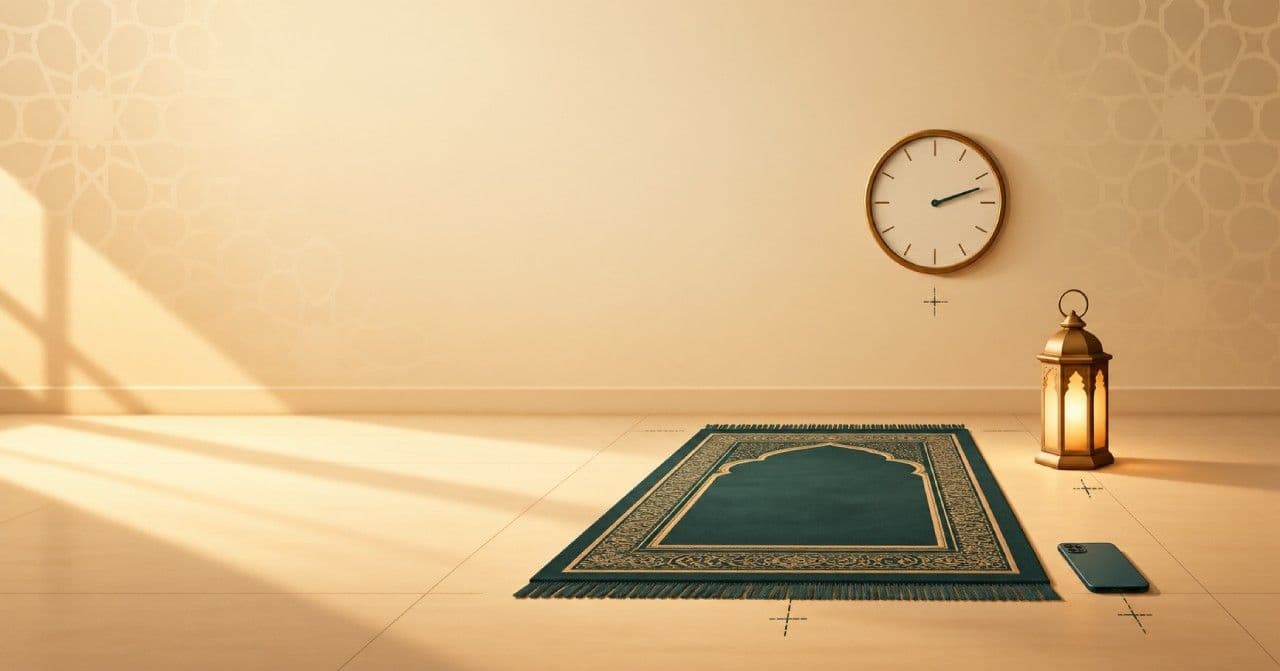
Key takeaways
- A first salah routine is a first build, not a restoration, for anyone who became Muslim without a household that kept the five daily prayers.
- Commitment is not the variable: in a 2022 US survey of converts of every vintage, they and Muslims raised in the faith attended weekly at almost the same rate.
- A praying household supplies a fixed time and place for free. In a study of student habits, a stable context predicted more automaticity; it did not measure prayer.
- The people belong inside the build rather than at the end of it. In exercise research, arrangements containing other people ranked above exercising alone; none of it measured prayer.
- How to keep the five daily prayers while still learning them is a question for a qualified scholar.
If you became Muslim without a family that prays, your first salah routine is a first build, not a restoration: the timetable, the place and the company all start at once. What a praying household would have supplied for free has to be chosen on purpose. Advice written for a rebuild does not fit, and the subject here is building the routine, not learning the prayer itself.
There is no earlier version of this routine to restore
If the five prayers were never kept in the house you grew up in, there is nothing here to restore. The timetable, the place and the company are all first builds, and they arrive together.
Two nearby situations are not this one. Someone returning to salah after years away is rebuilding something that once ran, and a four-week plan for coming back to salah is written for that. Someone who prayed at home and then moved into a first apartment is also starting alone, but works from a routine they have watched run.
The difference is not cosmetic. Advice written for a rebuild starts from a memory of the routine working and uses that memory as the template. A first build has no template, so the same instruction arrives as a blank. Learning the prayer itself is a separate task again: Muslim App, a prayer times and qibla app for iOS and Android, has an Islamic Guide that covers "Wudu, ghusl, and how to pray, with step-by-step visual instructions" for anyone who needs that part.
What the survey data says about converts and practice
Converts in the United States report practising at close to the rate of Muslims raised in the faith. Drawing on its American Muslim Poll 2022, the Institute for Social Policy and Understanding reports that "converts (42%) and born Muslims (41%) are equally likely to report attending a religious service once a week or more", alongside 94 percent of converts and 93 percent of born Muslims saying religion is important to their daily life. The same source puts the group at one in five: 20 percent of US Muslims were raised in another religion or none.
Two limits travel with those numbers. Attending a service is not the same measurement as praying five times a day. And the authors record that the research "does not include data on how long a convert has been Muslim", so it describes converts of every vintage rather than isolating the months just after someone becomes Muslim.
One difference does appear, at the other end of the scale: 22 percent of converts, against 13 percent of born Muslims, reported attending a mosque seldom or less often than a few times a year. The gap sits in that tail rather than in stated commitment, which is why the useful question is about the route into a routine rather than about resolve.
What a praying household supplies without anyone naming it
A household that prays hands over a stable time and place without deciding to. The adhan carries in from another room, dinner is held back until Maghrib has been prayed, someone else's mat is already unrolled in the next room. None of that is encouragement. It is a fixed context, supplied at no effort, and it is the part a first build has to replace.
Context is measurable. Stojanovic, Grund and Fries assigned 95 university students to build a new study habit over six weeks, instructing one group "to constantly vary the context of their habit repetitions by changing rooms and times" and the other "to keep the context of habit performance stable". Across that experiment and a second dataset of 308 habits from 218 users of a habit-building app, they report that "Context stability predicted more automaticity and higher habit repetition goal attainment."
The frame is as important as the number. Those were study habits among students, not salah, so nothing here was measured on prayer. What it establishes is that the steadiness of the surroundings does work of its own, which the authors put as context having "an ongoing effect on habit execution" rather than only triggering the behaviour.
Choosing the fixed points when the house does not supply them
The fixed points have to come out of your own day instead. What a household supplied by accident, a first build selects on purpose, and there are three pieces to select: the times, the place, and some record of what was prayed.
Begin with the times, since the rest of the routine hangs off them. Set prayer times calculated for where you live and leave them settled rather than re-checked each day. Then fix where: deciding the spot once, in advance, means the question is not reopened five times a day at the moment each time arrives.
The third piece is the one a household used to provide simply by being there, which is an external answer to whether the day happened. Muslim App's prayer guide describes marking a prayer as a way to "see whether you've completed your day". Getting from the reminder to the prayer itself is what the if-then plan for a slipping Asr covers.
The people are part of the build, not the reward for finishing it
Company belongs inside the first build rather than after it. A household that prays supplies both the times and other people praying, so when neither is inherited, both are open tasks in the same weeks. Writing about Eid, one convert describes the shape of that gap: once the prayer is over, "everyone goes out with their families to have food together and enjoy the day and I usually end up walking back to my car".
No study reviewed here measures this for salah. Research on exercise offers an analogy, with limits attached. Pooling 44 physical activity studies containing 214 effect sizes, Burke and colleagues found that exercising in a "true group", meaning a class deliberately built for cohesion, was significantly better than a standard class, which was in turn significantly better than exercising at home with no contact.
The weaker comparison in the same paper, exercising at home with contact against at home without it, was not statistically significant and rested on two studies. The authors also record that "no studies were located that contained a direct comparison between the true group condition and either of the home-based conditions." This is exercise rather than salah, and designed classes rather than congregations, so nothing here was measured on prayer either. What survives is an ordering in which arrangements containing other people sat above practising alone.
Who those people are is left open here: relatives, friends, a study circle, a local community. Should a masjid be the place you would rather try, the mosque directory covers your area, and a first visit is easier with some preparation.
Prayers from before Islam, and what is left to a scholar
Two questions arrive with this situation, and one has a settled answer: prayers not performed before you first became Muslim do not have to be made up, a point on which the Kuwaiti Encyclopedia of Islamic Jurisprudence records no disagreement. Ibn Qudama cites the Quran, "Say to those who have disbelieved [that] if they cease, what has previously occurred will be forgiven for them" (Al-Anfal 8:38, Saheeh International). In a hadith in Sahih Muslim (121), the Prophet ﷺ tells 'Amr ibn al-'As, who had asked to be forgiven, that "Islam wipes out all the previous (misdeeds)".
The other is how to keep the five daily prayers while still learning them, and whether someone who did not yet know a prayer was obligatory has to make up those missed after becoming Muslim. Which prayers of the day you became Muslim are owed is where the schools differ: al-Mughni records the Hanafis requiring only the prayer whose time was running, while the Hanbali text, Malik and al-Shafi'i also require, on differing conditions, the prayer before it that can be joined to it. Those are questions of fiqh for a qualified scholar, and a schedule does not answer them.
The first three decisions
Choose the three pieces before the first week rather than during it: the times, the place, and the person or group you would like to pray beside. A praying household issues all three at once and names none of them, which is why assembling them one at a time can feel slower than it is.
The work here is not extra resolve. It is choosing on purpose three things a praying house supplies by accident, and that choosing is a short piece of work next to the years the routine has to run. Set the times first, in Muslim App or anywhere you trust, and let the place and the people follow this month rather than someday.
Frequently asked questions
Possibly nothing about your intention. If you did not grow up in a household that ran the five prayers, you are assembling the schedule, the place and the company at the same time, which is a different task from restoring a routine that once ran. Research on student study habits found that a stable context predicted more automaticity, though it did not measure prayer.
About the author

Muslim App Editorial Team writes practical guides on prayer, building a consistent salah habit, and Muslim life at work and on the road. Where an article touches on religious rulings, it states only positions the four Sunni schools agree on, with their source, and leaves questions on which the schools differ, or that depend on your situation, to a qualified scholar. Our articles are not fatwas.